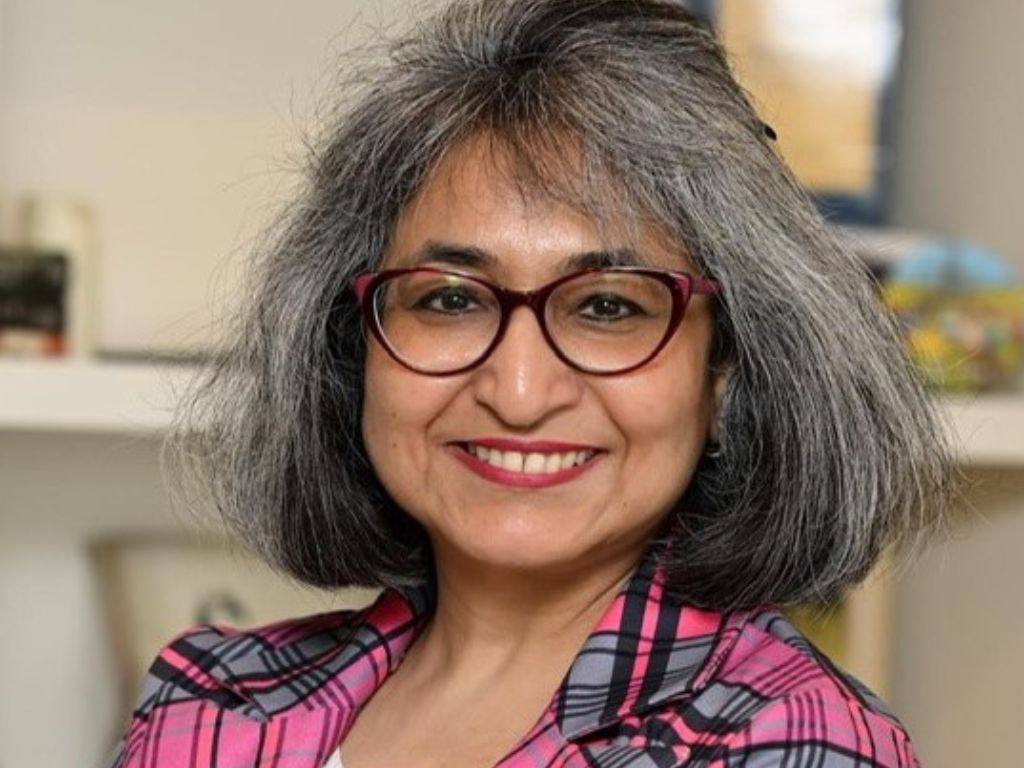
With over 33 years of experience in Fortune 500 companies, Arati Mukerji shares insights on transitioning to fractional leadership, driving strategic impact during scaling phases, and how organizations can accelerate growth through senior expertise, agility, and clarity.
Arati Mukerji is a proven global brand transformer with over 33 years experience with Fortune 500 companies across sectors. Having served in global and regional leadership roles, she works at the intersection of brand strategy, communications & marketing, change & crisis management and sustainability. She has also served as a Board Member, Company Spokesperson and collaborated with international bodies on international subjects such as sustainable mobility and road safety. Her perspectives have been published in the book titled ‘Advertising at the Crossroads’ by world renowned advertising guru Prof. John Philip Jones, and authored articles in management institute publications.
Fractional Insider: How was your transition from a traditional career to fractional leadership/consulting?
Arati: It was an intentional shift for me. After years in a traditional career, I realized that the challenges I enjoyed solving most were at the intersection of strategy, velocity, and impact. Moving into global brand management consulting and fractional leadership has allowed me to do exactly that, and deepdive into companies at a stage where they need seasoned guidance along with a strategic plan to deliver on it.
What energized me was stepping into ambiguity, diagnosing issues, aligning brand strategy with business ambition, and defining long-term strategic vision & direction with a future-focused lens.
It was a “step fast” and “step into” a more agile, high-leverage way of working. I shifted from being accountable for one company’s growth to influencing the growth trajectories of several and help each with its own culture, ambition, and complexity.
This transition also required a mindset shift for me personally. From being embedded in one company ecosystem to quickly understanding and integrating into many to make a difference and help in their trajectory has been tremendously exciting and enriching. It’s given me great learnings of diverse sectors with solving their problems, testing premises, to faster learning cycles, and the opportunity to create real, measurable impact.
In many ways, it has made me a sharper, more empathetic, and a more future-focused leader. I would say, the transition has been a progressive learning process evolving from short-term assignments to now as full-fledged leadership roles.
Fractional Insider: What attracted you most to this model, and what challenges did it bring?
Arati: I believe the timing was right for me especially because it was the time when the acceptance of companies looking for professionals with high caliber experience and expertise increased and the global macroeconomic environment became conducive to talent globally.
In fact, I wanted to venture out to test the waters and set up something that would give me a platform for a second inning in my career with some flexibility. The fractional cum management consulting model offered me just that. This model allowed me to focus on long term strategy where my expertise would make the maximum impact for a business and pick the right projects.
This has also aligned deeply with how I lead. I’ve always believed leadership is about enablement, empowerment and evolution. In a fractional role, your authority comes from trust, credibility, and outcomes coupled with experience-driven expertise. That has been incredibly energizing for me.
At the same time, it is important to earn trust faster, listen more intently, influence without the comfort of formal power and, ensure you don’t step on anyone’s shoes. Context-switching is constant, and you need strong personal discipline to avoid spreading yourself too thin. There’s also an emotional shift from owning long-term execution to empowering teams for accelerating the vision forward. It helps sharpen you as a leader with clarity, humility, and precision. I’ve found that this model has sharpened my leadership and be focused on the business need.
Fractional Insider: How do you choose the projects and clients you work with?
Arati: Companies that are looking to scale across multiple geographies or trying to solve a brand cum business issue or brand perception issues or looking to get into market expansion beyond the home market are largely the projects that resonate with me and help me make a difference to them.
Sometimes, its also brands that want to reimagine or companies that are birthing a new brand I’m very deliberate about this. I gravitate toward companies that are at a scaling or transition stage— especially those looking to expand across multiple geographies, entering new markets beyond their home base, or solving complex intersections of brand and business strategy.
Building the right foundations to grow sustainably, credibly, and globally are the ones I partner with. Projects where the question goes beyond “How do we grow?” to “How do we grow meaningfully and sustainably?” This will involve reimagining an existing brand, architecting a market-entry strategy, or incepting an entirely new brand with a clear purpose and commercial logic.
Ultimately, engagements where I can make a real difference are at the intersection of leadership expertise, strategic growth and execution discipline.
Fractional Insider: Tell us about a moment when you had a major impact as a fractional leader.
Arati: When a company is strong in its home market, it’s difficult to understand that the same success will not translate across geographies. I have worked with Founders to develop sharp brand narratives, go-to- market and sometimes to tune the business strategy to align with local issues for the brand to resonate. This meant realigning and redefining the focus, building a powerful value proposition and developing a positioning that’s globally relevant and culturally nuanced. As a result, this company has been garnering interest from multiple geographies and confidently entering new markets and accelerating pipeline momentum. More importantly, the leadership team moved from reactive execution to proactive scaling.
Fractional Insider: What are the main differences between being a full-time executive and a fractional one?
Arati: A fractional resource is a seasoned expert brought in for strategic projects and/or impact vs a full-time executive who is responsible for running the function or business on a continuous basis and is focused on only one company.
In a fractional role, the leader is focused on catalyzing change by solving a specific business challenge, issue, need such as scaling the business, entering new markets, reimagining the brand, creating a new brand etc. With the intent of delivering high value, fractional leaders bring ownership and accountability linked to business outcomes. They embed in the organization like a full-time executive to redesign or accelerate business or brand at critical junctures. Companies bring in fractional leadership when they need senior expertise, with speed and objectivity without the cost or complexity of a full-time hire.
Fractional Insider: How do you explain the value of a fractional leader to a skeptical CEO?
Arati: A fractional leader’s value is best explained by focusing on strategic intent and business outcomes where experience matters most. While I haven’t personally encountered such a situation, highlighting to CEOs the work you do as accelerating business progress in areas that directly impact revenue, brand or market position resonates really well.
In addition, it is critical to position yourself as a strategic value add to the CEO, as someone who brings experience, a worldview perspective, wider industry understanding, quick strategist and executioner, helping navigate complexity. The CEO clearly sees the benefit of accelerating the organisation on a faster and smarter trajectory.
CEOs understand how the Fractional leader benefits their specific business need very quickly. As you go deep-dive into the specific industry and company challenges and how you can address specific inflection points of scaling, turnaround, reimagining, expansion, etc CEOs are quick to leverage your expertise.
Considering that as a Fractional leader you work across multiple companies, industries and growth stages, you enable CEOs to compress years of learning into decisive action with agility. Ultimately, it is upto you as a Fractional leader to highlight your hyper-specialization and win the CEO’s confidence.
Engagements can scale up or down but processes must be clearly defined with disciplined precision to ensure transparency on both sides.
As a strong fractional leader you are an enabler helping the company and the CEO elevate the business by focusing on strategically building internal capability and clarity, enabling the CEO and leadership team accelerate with greater confidence.
Fractional Insider: What are the most common mistakes companies make when working with fractionals?
Arati: I believe there are learnings on both sides – the Company and the Fractional leader. Very often businesses confuse you as part-time employees taking away from the strategic intent of the assignment. Also, for a Fractional to make a difference, it’s critical to get to the root cause assessment very quickly. Hence, businesses must be open in sharing everything openly for the outcome to be strategic and impactful.
Fractional Insider: How do you see this career model evolving in the coming years?
Arati: The future of work for experienced professionals is fractional. Several trends are supportive of this new phenomenon:
- Startup ecosystems globally demand more mature resources that can help new ideas show results with agility and acceleration
- There are more progressively emerging small and medium enterprises that are in need of specialized guidance.
- Digital transformation is putting pressures on different industries and people for learning new skills and managing newer systems and processes with speed and high adaptability.
- The complexity and speed of the AI world is forcing businesses to navigate a change and shift ever so often with limited lead time.
Fractional leaders are already present in several markets and, will rapidly evolve worldwide. Their expertise is extremely valuable at current times where the speed of technology transition is exponential and high-stakes businesses require faster speeds of measurable success. These resources will become the cornerstone of the hybrid economy going forward.
The hyper-specialized leaders will become a robust ecosystem of top talent globally for functions like technology, marketing, finance, HR, etc. Their strategic expertise is extremely modular, outcome-driven, and widely accessible, enabling organizations to innovate faster and leaders to deploy their skills across multiple high-impact missions easily.
Fractional leadership will answer the very specific need of business leaders in how they win by making smarter decisions, faster. The future of fractional roles is a reset in how leadership is accessed and allowing companies to bring in senior expertise exactly when it matters most — during moments of scale, disruption, market entry or reinvention.
At the same time, the idea of a linear, full-time executive career is breaking down. Many experienced leaders are choosing portfolio paths, applying decades of hard-won insight across multiple organisations. That shift is creating a powerful talent layer of leaders who are outcome-driven, independent in thinking, and highly focused on velocity and impact.
With remote work eliminating geographic barriers, fractional leadership will expand for varied disciplines beyond finance and marketing into growth, technology, product, operations and culture. It will become a default lever for Boards, investors and CEOs who want speed, quality, precision, agility with trust and transparency.
Fractional Insider: What advice would you give to a senior professional considering becoming fractional?
Arati: Be clear, be focused and be intentional is what I would say. You should take this path with high intent and clarity of thought with strategic focus.
Going Fractional is a strategic shift and not a career break or retirement plan. Fractional leadership is about doing higher-stakes work with sharper intent, faster speed, and accelerated shifts. You have to be absolutely clear about your strategic edge. Be distinct in defining the specific inflection points where your experience creates value creation, whether that’s scaling across geographies, enabling growth, entering new markets, navigating transformation, or reimagining a business or brand, ensuring stakeholder management, etc.
As a Fractional leader you have to succeed without formal authority. Your power comes from judgment, credibility and the ability to align people quickly. This means being comfortable challenging Founders and CEOs, while staying deeply pragmatic and grounded.
Think in portfolios, not positions. You are no longer managing a job. You are managing reputation, value, equity, scale, growth and capacity across multiple engagements. It’s important to select clients carefully, set clear success metrics upfront, and protect your time fiercely.
Fractional leadership rewards those who are confident enough to trade titles for trust, presence for impact, and security for relevance. Done right, it’s a step up in your strategic influence.
Arati Mukerji’s journey shows that leadership is no longer defined by permanent presence within a single organization, but by the ability to create clarity, direction and measurable results where the stakes are highest.