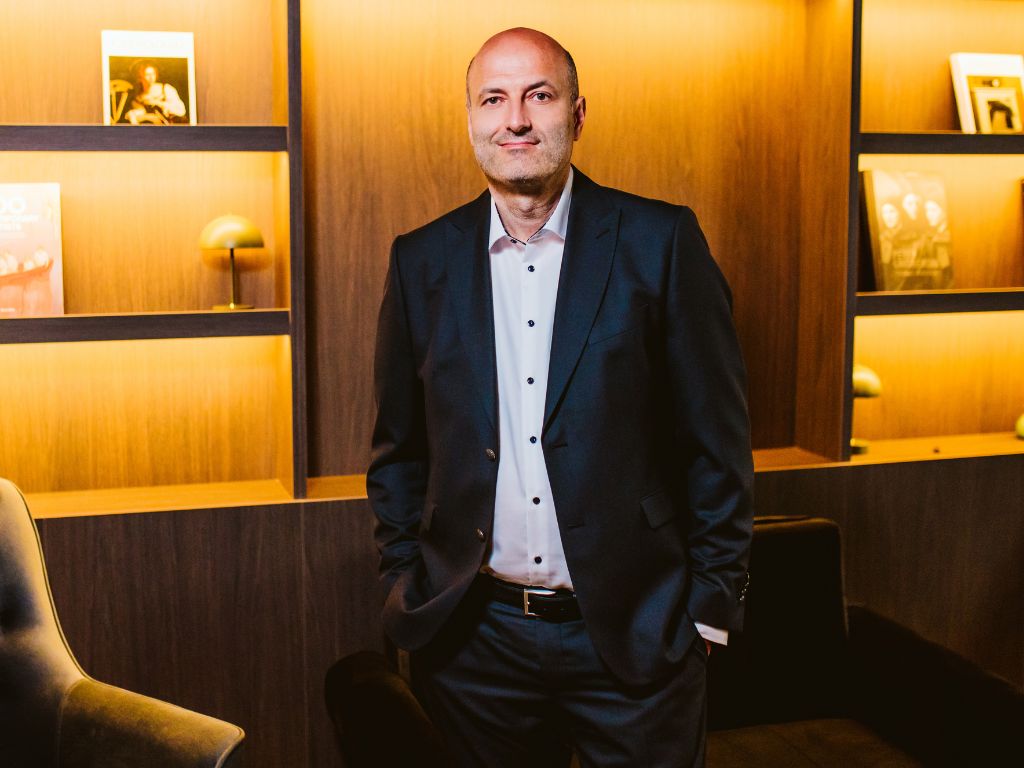
From payroll to productivity: how companies turn HR from an administrative function into a competitive advantage. Ciprian Chiorean explains the role of strategy, technology, and organizational culture in sustainable scaling.
For founders who want to scale intelligently, HR can no longer remain an administrative function. Workforce planning, digitalization, AI, and organizational culture are already growth tools, not just internal processes. Ciprian Chiorean, GM SD Worx Romania, talks about the maturity threshold that transforms HR from an operational cost into a strategic differentiator.
Fractional Insider: The SD Worx study talks about the shift from operational HR to strategic HR. What does this transformation concretely mean for an entrepreneur who wants to scale?
Ciprian: For an entrepreneur looking to scale, the shift to strategic HR essentially means no longer viewing this area as an administrative function, but as a direct growth driver. Operational HR keeps the company compliant; strategic HR prepares it for the next level. This involves workforce planning, a clear organizational structure, performance systems, and leadership ready for growth. When these elements are aligned with financial objectives, HR becomes part of the scaling architecture, not just a support department.
Fractional Insider: When does HR become a cost and when does it become a real competitive advantage? What is the organizational maturity threshold?
Ciprian: HR becomes a cost when it is reactive—when it only intervenes to solve problems instead of preventing or anticipating them. It becomes a competitive advantage when it directly influences the retention of critical talent, productivity, and organizational culture. The maturity threshold usually appears when the organization grows to a point where complexity can no longer be managed informally. From that moment on, processes, data, and HR strategy make the difference between sustainable growth and chaotic growth.
Fractional Insider: In fast-growing companies, what are the most common mistakes you see in the people & payroll area?
Ciprian: The most common mistake is hiring under pressure, without medium-term planning. Then, payroll is often treated as purely administrative, although it is a critical area for compliance and internal trust. We also see a lack of process standardization before scaling and an underestimation of legislative complexity. In Romania, the legal framework is dynamic, and errors can have significant financial and reputational impact. That is why payroll infrastructure must be treated as strategic infrastructure.
Fractional Insider: Digitalization and AI are already present in HR. Which processes deliver the fastest ROI and where are the risks still underestimated?
Ciprian: The fastest ROI is seen in payroll automation, time management, and the digitalization of repetitive processes. Reducing errors and gaining access to real-time data bring immediate efficiency. In the AI space, recruitment and analytics are the first visible benefits. However, risks arise when technology is implemented without clear governance, adequate data protection, or organizational readiness for change. Technology accelerates processes, but if the processes are not solid, it also accelerates vulnerabilities.
Fractional Insider: How do companies in Romania compare to Europe when it comes to adopting HR technology and integrating AI? Are we behind or catching up fast?
Ciprian: Romania had a slower start compared to Western Europe, but in recent years the catch-up has been visible. We are seeing a steady increase in payroll outsourcing and a rapid migration to cloud solutions. Interest in AI and in using data for HR decision-making is growing. The gap is no longer technological, but rather one of organizational maturity and readiness for change. The pace of adoption is clearly accelerating.
Fractional Insider: The study mentions sustainability and organizational culture as retention factors. For a pragmatic entrepreneur, how does this translate into measurable indicators?
Ciprian: For a pragmatic entrepreneur, culture and sustainability must be translated into numbers. We are talking about retention rate, turnover cost, time to productivity, engagement level, or absenteeism rate. A healthy culture reduces hidden costs and increases stability. Sustainability is not just a reputational concept, but a mechanism that ensures predictability in workforce costs and long-term execution capacity.
Fractional Insider: Flexibility and wellbeing remain central topics. How can leaders integrate them without losing control over performance and costs?
Ciprian: The key is shifting the focus from presence to results. When objectives are clear and performance is measured through relevant indicators, flexibility does not reduce control—it makes it smarter. Wellbeing should be viewed through the lens of productivity and retention, not just as a benefit. Data and transparency help leaders balance flexibility with financial discipline.
Fractional Insider: What risks arise if a company continues to treat HR as a strictly administrative function in 2026?
Ciprian: The main risk is losing competitiveness. Companies that remain stuck in an administrative model will struggle with talent retention, incur higher recruitment costs, and have limited visibility into the total cost of the workforce. Moreover, in a volatile legislative and economic context, the lack of a strategic approach increases vulnerability. In 2026, organizational agility will be a major differentiator.
Fractional Insider: If you were to send a single message to founders and leaders in the Fractional community about the next 3–5 years, what would it be?
Ciprian: My message is that the coming years will not be about how fast we grow in volume, but how efficiently we grow in productivity. Organizations that use data, integrate technology responsibly, and treat human capital as a strategic asset will have a real advantage. HR is no longer a support function; it is the infrastructure that enables scaling and long-term resilience.
In a constantly evolving economic and technological landscape, the companies that will succeed are not those that grow the fastest, but those that grow the smartest. And that starts with how they build and manage their human capital. HR thus becomes not just a business partner, but a core infrastructure for the future.