How a Fractional CMO builds AI-enabled growth systems in 90 days to scale D2C and consumer brands with measurable results.
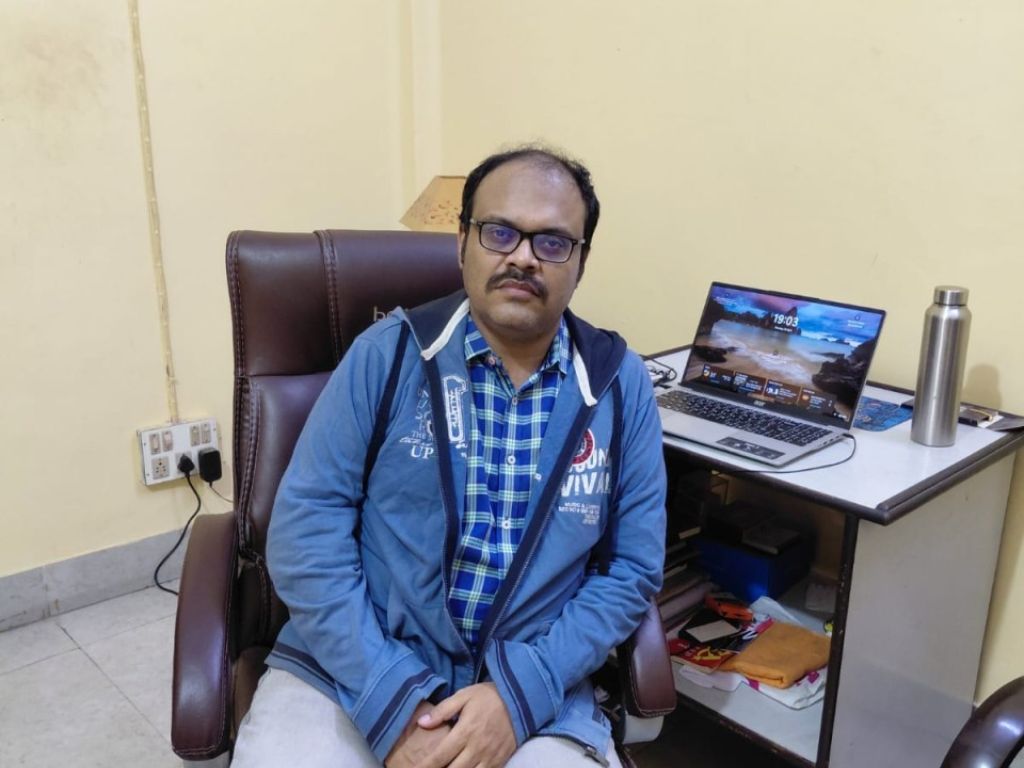
Sagnik Guha spent 2 decades inside some of the most challenging marketing organizations across India, South Asia and Europe before making the deliberate transition to the Fractional leadership model – one built around systems. As a Fractional CMO and Growth Partner, he embeds with the leadership teams in D2C and consumer brands as a diagnostic-first growth system architect – identifying the true growth levers before building the playbook to scale it. His corporate track record includes building an USD20mn omnichannel topline business from scratch with Reliance Retail, transforming the USD100mn traditional retailer Apex Footwear into a modern digital loyalty-led growth engine and leading the Danish EdTech brand SKIDOS through a growth period during a phase of double-digit category decline across US and EU markets. Through SME360Digital, he now offers Founders and leadership teams a Growth Operating System through a 90-day engagement – AI-enabled, outcome-driven and designed to run independently once he steps back.
Fractional Insider: How was your transition from a traditional career to fractional leadership/consulting?
Sagnik: The transition after 20 years of corporate career was a process of navigating through a path of self-discovery, learning to operate and multi-task with little resources and forging new relationships.
The first major shift was the hardest – letting go of financial predictability. Initially, for the first year, I looked at operating on long-term retainer-based models that gave a sense of continuity. However, I realized this model defeats the purpose of becoming a Fractional – I wanted to build something more impactful.
That’s where I made a shift – I moved away from open-ended retainers and designed a Growth System as a Service model – a 90-day program designed around 3 layers of Diagnose – Decide – Operate for consumer businesses (Retail, E-commerce, Omnichannel businesses). The outcome is a fully functional AI-enabled Growth Operating System embedded inside the client’s team. It is a productized module.
The model changed everything – it let me work with more businesses, compound my own learning across sectors and helped deliver meaningful outcomes faster. The clients got a fully designed and operated system without a long-term commitment.
Fractional Insider: What atracted you most to this model, and what challenges did it bring?
Sagnik: I think the key attraction was intellectual freedom – I wanted to have some control on the problems that I wanted to solve. While I knew that a corporate role offered many perks, I also started to see the playbook of a successful career moving up the corporate ladder beginning to see its limits. Deep entrenchment into one business was increasingly being outpaced by cross-sectoral pattern recognition that comes from working across multiple categories.
The first year was extremely challenging – project delivery, business development, offering refinement – doing all that alone with no institutional safety net is overwhelming and lonely. What made it different was when I started treating my service as a product – that led to the creation of the 90-day Growth System model which gave both me and my clients a structure. Secondly, I started connecting with other Fractional communities and practitioners who were navigating the same transition – it started giving me a sense of community and shared learnings.
Fractional Insider: How do you choose the projects and clients you work with?
Sagnik: This is one of the most important skills I have developed. Earlier in my practice, my primary criteria was a minimum 6-month retainer-based model for stable revenues. However, I realized that client fitment was far more important to build a successful Fractional practice.
Today I look at client fitment primarily from two perspectives:
Firstly, I look at whether the Founder and the Leadership team appreciate system thinking – teams that see value in building a sustainable Growth and Marketing Operating system as a genuine differentiator.
Secondly, I try to understand whether there is buy-in in engaging a Fractional – an engagement fails when I have to operate in silos. If there is Leadership buy-in, then the entire team works together to make the partnership successful.
Fractional Insider: Tell us about a moment when you had a major impact as a fractional leader.
Sagnik: I would like to talk about my experience with this Clean Label Food brand built around sustainably sourced ingredients – approximately a USD2mn revenue operations.
Key Challenges
– Flat topline for 2 consecutive years after post-COVID consumer spending receded.
– Based on new demand post Covid, the company invested substantially in its production capacity, opened new outlets and was trying to make the digital channels a success. Unfortunately, new investment coincided with diminishing demand.
– The physical dine-in channels started seeing footfall drops.
– The new digital business was leaking ROI.
I started with running a full business diagnostic:
– The brand’s new investments were not amongst the product lines that were growing the fastest in the category, rather in experimental new categories.
– While the brand was investing in building its own digital channels, it didn’t try out the fastest growing E-commerce channel in this category (Quick Commerce).
– The brand’s digital strategy didn’t focus on growth around a set of Hero SKU’s, didn’t drive habit formation (repeat purchase levers were absent) and only focused on market expansion.
– Consumer feedback process was weak.
– Overall Unit Economics was coming under strain.
I started making the changes – one at a time and continuously evaluating the results at each level.
– Proposed a reduction in production capacity of slower-moving SKU’s
– Proposed a Quick-Commerce launch with 4 HERO SKUs in micro geographies seeing the highest ROI on own channel
– Cut digital budgets on low ROI geographies, put in place a retention program meant to drive habit formation, category expansion and lower discount depth in subsequent purchases among existing customers –objectives were growing LTV, reducing CAC Payback and improving Unit Economics.
– Identified Ready-To-Cook as the fastest growing category – proposed a new investment with just 3 SKU’s (it was only accepted after 8 months after other initiatives worked)
The 180-day and 365-day results were there to see:
– In 6 months, Quick Commerce became a profitable channel contributing 4% of topline with just few SKUs – built entirely on repeat demand and sequentially lower advertising cost.
– The key own channel saw a 12X growth in first 6 months (MRR) and stood at 16X by Month 12 – with 4 out of the last 6 months being profitable on a standalone basis and retention cohorts improving steadily.
– Overall, the brand saw 10% top-line growth after 2 flat years with Digital Channels contributing to the entire growth.
Fractional Insider: What are the main differences between being a full-time executive and a fractional one?
Sagnik: The key difference between the two is the following in my view:
In a full-time role, I owned the brand’s outcomes across a multi-year horizon. As a Fractional, the clock starts from Day 1 – I own specific outcomes of the client for the 90-day period. Hence there is no room to compensate for a slow start as a Fractional. The degree of accountability is actually higher since you need to deliver defined outcomes within the 90-day window.
The second key difference is that I get to work on multiple such projects concurrently – it has significantly added to my pattern recognition capabilities across multiple sectors simultaneously. I am continuously pressure-testing my frameworks against new business models – each such endeavor sharpens the model further which I deploy on the next.
The third and probably the one CEO’s think the most about at least at the consideration stage is purely economic. A Fractional executive delivers a C-Suite capability and an operational execution model at a fraction of the cost of a full-time hire without long-term commitment. The engagement model I use – a Build-Operate-Transfer one means that the client gets a completely self-operated system that is also tested for some time against actual business processes and outcomes.
Fractional Insider: How do you explain the value of a fractional leader to a skeptical CEO?
Sagnik: The first thing that I do here is to acknowledge their skepticism – most have worked with Consultants or Agencies who have handed over a strategy deck. What I offer is structurally different. I don’t create decks. I build a Growth Operating System inside their team within 90 days
In my first conversation itself, I introduce them to the concept of a Growth System and demonstrate the structural inefficiencies in their existing Growth Engine using their own data points. I explain that the Marketing and Growth Engine is actually an interconnected system of PMF, Acquisition Funnel, ICP-Messaging fitment, Retention funnels, Customer Feedback etc. where a structural gap in one lever impacts the whole funnel.
Now this is a fundamentally different conversation from what the CEO has with his internal teams who introduce him to a new dashboard every day. Most companies do capture plenty of data-points but struggle to create a data-driven marketing engine – one that diagnoses, decides and helps revise existing workflows.
Fractional Insider: What are the most common mistakes companies make when working with Fractionals?
Sagnik: I think the most common one is companies think of Fractionals as consultants who just hand over a deck. Fractionals are leaders who embed themselves within the Executive team and are equally responsible for driving real business outcomes within the defined scope.
Secondly it is restricted access – Fractionals can only diagnose what they can see. I’ve faced situations where the leadership wants strategic recommendations but are reluctant to provide full access to data, platforms, accurate attribution etc. Clean data access and proper organizational context are the inputs for a good systems design.
The final one is where there is inadequate buy-in at all levels for engaging a Fractional. The most successful projects that I have done are the ones where the internal teams were completely aligned and engaged during both the system design as well as implementation stages. They were very forthcoming to implement the redesigned workflow and continuously seeing the results rather than executing the old playbook which creates contradictory outcomes.
A successful Fractional project to me looks like a self-operated system tested and measured against agreed outcomes – and designed to incorporate new learnings that make results compound over time. A classic Build-Operate-Transfer model.
Fractional Insider: How do you see this career model evolving in the coming years?
Sagnik: I think Fractional model is at an inflection point. The early adopters were primarily start-ups – from early / seed stage to Series B where capital efficiency is critical. The next wave is the mid-market and enterprises who have started understanding that the challenge is not just access to talent but effectively deploying them. A Fractional leader embedded for 90 days with a specific mandate can create a far more measurable impact than a full-time hire who operates without a compact outcome-driven model.
The other trend that I see is that Fractionals who have an AI-driven playbook in their domain area are able to deliver much more than what a large team of multiple people can – Fractionals are independent operators who are used to running diagnostics, deriving decisions and building workflows autonomously. This fundamentally changes the economics both from cost as well as AI amplification perspectives.
I am watching the Asian markets closely – South-East Asia (except Singapore), Gulf and GCC markets are still few years behind US and UK in Fractional adoption but the demand conditions are forming – high growth Founder led consumer brands that move fast don’t necessarily have senior level capabilities available locally at a cost they are comfortable with – that gap will open the next frontier to this model adoption in my opinion.
I see the future of leadership (5 years down the line) as a hybrid model – leadership teams will have substantial chunk of Fractional executives in them.
Fractional Insider: What advice would you give to a senior professional considering becoming fractional?
Sagnik: I would suggest five things that I have learnt during my journey so far:
a) Get into Fractional communities and build deeper relationships with other Fractionals – don’t undertake this journey alone. If possible, do some joint projects with others since it substantially improves the quality of output. Also consider doing some joint White Papers and research work.
b) Have a giving attitude – help as many people as possible, including giving away free value to both Founders and the Fractional community. In the beginning, monetization shouldn’t be the primary objective. It is important that the wider community starts trusting you – for quality, authority, guidance, collaboration and mentorship. Feedback and interactions from free workshops and webinars are great ways to understand real business challenges and finetune offers.
c) Build a MOAT – A successful Fractional needs to be a specialized operator, proven in solving problems in a specific niche. It is good to pick the right projects in order to build a set of successful case studies in your niche. This helps build your authority and a personal brand in the domain for the long term. Also, it is better to have some playbooks that can be deployed with minimal customization.
d) Continue to build deeper skills in your domain – invest 10% of your weekly working hours in learning.
e) Finally, building a Fractional business is just like building any other business – part of the investment (mostly in terms of time, effort and money) needs to be done upfront – that ensures long term value. It is critical to be patient. An 18-month cycle might be a good time to make an honest assessment of progress.
An interview exploring the shift from corporate to fractional leadership and how scalable, AI-enabled growth systems can be built in just 90 days. Sagnik Guha breaks down the difference between strategy and execution, the role of systems thinking in marketing, and how D2C brands can achieve measurable results without long-term commitments.