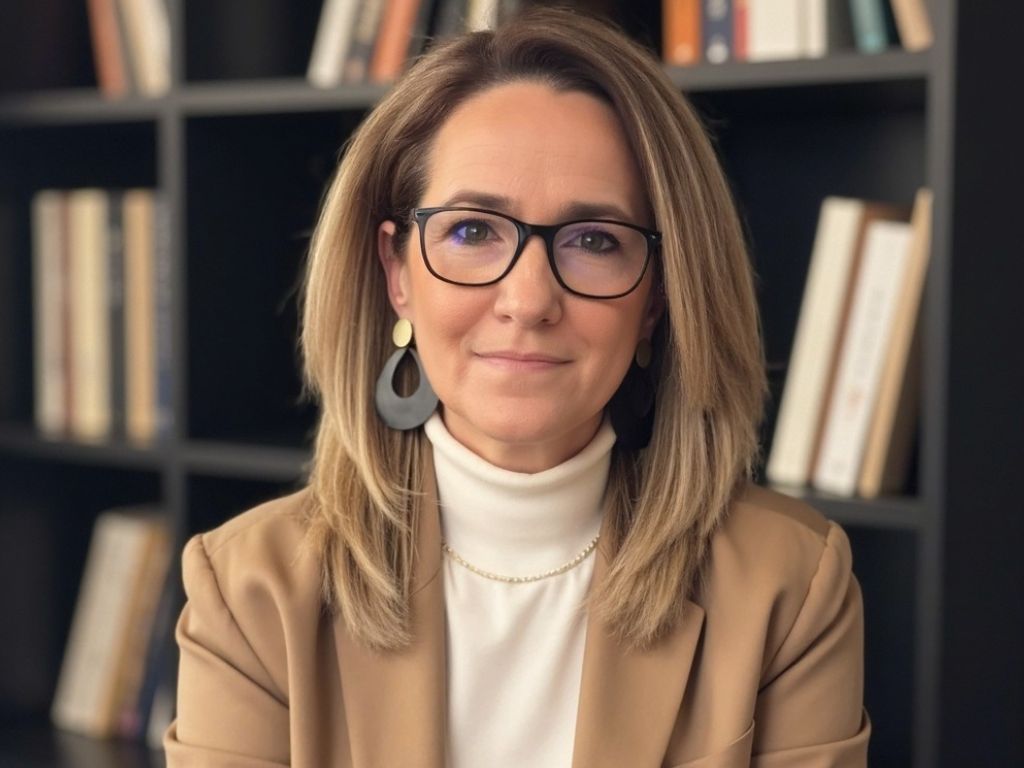
With over 15 years of experience alongside entrepreneurs and transforming organizations, Petronela Sănduleasa reflects on the shift to fractional work, real impact, clarity, and professional maturity.
Petronela Sănduleasa has been working for over 15 years in close proximity to entrepreneurs and organizations in phases of building or transformation. Throughout this journey, she has consistently been close to business decisions, holding various roles and positions, contributing to the alignment of people, structures, and processes that support growth.
Over the past 2–3 years, she has continued to work alongside founders and teams, but from a different position: a more flexible one, adapted to the real needs of each organization. Her contribution has taken various forms, from working with people and teams to structure, processes, or projects involving the implementation of digital solutions and HR applications, without fitting into a single role or a classic format. This way of working emerged naturally from the concrete realities of organizations, not from a career plan defined from the outset.
Today, this positioning allows her to remain close to both business and people across multiple contexts, while maintaining the clarity needed to intervene where her contribution is truly relevant.
Fractional Insider: How was your transition from a classic career to fractional leadership/consulting?
Petronela Sănduleasa: There was no clear break or sudden decision to change direction. My transition was not a singular moment, but a process that unfolded over time, as the types of needs around me changed. It was much more connected to organizational realities than to a pre-built career plan.
After years spent in internal, classic roles, I began to be increasingly involved in contexts where organizations needed clarity and structure, but not necessarily a full-time role. Sometimes my intervention was related to people and teams, other times to organization, processes, or projects implementing digital solutions and HR applications, during moments of building or transition.
At first, I didn’t label this way of working in any way. I simply responded to concrete needs, in different forms, depending on the context. Only over time did I realize that this is the type of contribution in which I function best at this stage of my professional life: entering a business, quickly understanding what is happening, bringing clarity, and helping to put things in place where needed.
For me, this way of working became natural precisely because it allows me to be useful without forcing structures that are not yet ready or necessary.
Looking back, the transition was not about giving something up, but about assuming a different position toward business and people—one that is more flexible, yet with the same level of responsibility toward decisions and their impact.
Fractional Insider: What attracted you most to this model, and what challenges did it bring?
Petronela Sănduleasa: What attracted me most was the possibility to design interventions adapted to the reality of each business, without being constrained by a standard role or formal expectations that, in some contexts, can limit flexibility and speed of response. This way of working allowed me to be more honest about what I can offer and to focus on impact, not on form, title, or conventions.
At the same time, it comes with real challenges. It does not offer the same predictability as a classic role and forces you to define very clearly your boundaries, responsibilities, and success criteria. It requires a great deal of discernment in choosing the right contexts and the ability to say “no,” even when opportunities may seem attractive at first glance.
For me, the challenge has been—and remains—maintaining the balance between involvement and the necessary distance to see things clearly. It is a way of working that requires professional maturity and accountability, but when well understood, it creates space for better decisions and relevant interventions for both sides.
Fractional Insider: How do you choose the projects and clients you work with?
Petronela Sănduleasa: I don’t choose projects based on industry, size, or notoriety, but on context and the people within the organization. Above all, I look at the stage the business is in and the real need behind the request, not the title under which it is formulated.
It matters a lot to me that there is openness to clarity and an authentic willingness to build, not just a desire to validate decisions already made or to quickly tick off a solution. Results are most visible in contexts where expectations are honest and there is an assumption that some things need time to settle naturally.
I am also attentive to the role I can truly play within an organization. If I feel I can bring a relevant contribution, I engage responsibly. If not, I prefer to say no. For me, the fit between context, people, and type of contribution is what makes the difference between a formal collaboration and one that truly works.
Fractional Insider: Tell us about a moment when you had a major impact as a fractional leader.
Petronela Sănduleasa: For me, major impact has never been tied to a spectacular project or a change that is visibly impressive from the outside, but to moments when things became clear for the people I was working with. Most often, these moments appear when an organization is in a state of confusion or overload and can no longer distinguish what is essential from what is secondary.
I have been involved in contexts where, by clarifying roles, responsibilities, and real priorities, the pressure within the team visibly decreased and decisions began to be made more coherently. Sometimes the impact came from calling things by their name; other times, from creating a framework in which people could function better, without constant intervention.
For me, real impact means leaving a context with structure, clarity, and less unnecessary tension behind. If the organization can move forward without me, I know the intervention has achieved its purpose.
Fractional Insider: What are the main differences between being a full-time executive and a fractional one?
Petronela Sănduleasa: I perceive the difference between a full-time role and a fractional one not as a difference of level or importance, but of positioning.
In a full-time role, you are part of the organization’s daily system and contribute to long-term stability and continuity. As a fractional, you enter a context with a more clearly defined mission and a different time horizon.
The fractional role requires you to quickly understand the business, the people, and the internal dynamics, while also maintaining enough distance to see things clearly. This combination of proximity and detachment allows you to ask difficult questions and bring clarity where, from the inside, things can become opaque.
For me, the essential difference is related to responsibility. It is real in both forms, but in the fractional space it is concentrated on impact and clear outcomes, not on constant presence or formal belonging.
Fractional Insider: How do you explain the value of a fractional role to a skeptical CEO?
Petronela Sănduleasa: I don’t start from the idea that there is a universally valid solution or that the fractional model is suitable for every context.
Often, a CEO’s hesitation comes from very concrete realities: market pressure, decision-making responsibility, organizational history, or the type of challenges they are facing at that moment.
From my perspective, the value of a fractional role is always explained in relation to the business context. In volatile markets, where flexibility and cost control become critical, hybrid models can be a legitimate option—not because they are “trendy,” but because they allow the variability of decisions that would otherwise remain rigid.
I have rarely encountered situations where I needed to “convince” a skeptical CEO. Rather, I have noticed that openness appears when the discussion shifts from form to real needs: what problem needs to be solved, over what time horizon, and with what level of accountability. Within this framework, the fractional model becomes a natural way of working, not an imposed solution.
Fractional Insider: What are the most common mistakes companies make when working with fractionals?
Petronela Sănduleasa: I wouldn’t speak about “common mistakes” in the classic sense, because the fractional model is still at an early stage in the local market, and many organizations experiment with it without naming it as such. Most of the time, we are in a space of exploration rather than one of acknowledged errors.
From what I have encountered so far, blockages appear mainly due to a lack of shared language and clearly formulated expectations. Some organizations enter flexible collaborations without having clarified internally what they truly want: operational support, strategic clarity, or a thinking partner during a transition. In the absence of this clarity, the collaboration becomes diffuse and difficult to evaluate.
I think it is also important to say that, in many cases, what we today call “fractional” already happens in the form of operational consulting or punctual interventions. The difference is not necessarily one of competence, but of framework and the organization’s maturity in working in a more flexible way. For this reason, I wouldn’t speak about mistakes, but about the fit between moment, context, and the chosen type of collaboration—where this fit exists, things tend to work naturally.
Fractional Insider: How do you see the evolution of this career model in the coming years?
Petronela Sănduleasa: I believe the evolution of this model has less to do with the “fractional” label and more with how organizations begin to define their real needs. A fractional job is not, in essence, about seniority or status, but about volume, clarity, and the type of expertise required at a given moment.
At a global level, there is already visible growth in roles described as flexible, part-time, or fractional, especially in more mature entrepreneurial ecosystems. Without speaking about a clear standard, these signals indicate a shift in how businesses choose to access specialized expertise, without necessarily anchoring it in permanent structures.
I believe many organizations will continue to use this type of collaboration without explicitly calling it “fractional,” combining internal roles with punctual interventions or expertise delivered in a flexible framework. In this sense, I don’t see a revolution of titles, but a natural adaptation to cost pressures, the pace of change, and the need for agility.
For me, this is a sign of maturation: work begins to be designed more around real needs and less around fixed formats.
Fractional Insider: What advice would you give to a senior professional considering becoming fractional?
Petronela Sănduleasa: I’m not sure I would frame this as general advice, because every professional journey is different and highly context-dependent. I can, however, share what was important for me and what I would invite anyone to clarify before making such a decision.
For me, it mattered greatly to understand what kind of contribution I can truly bring and in what contexts I function well. The fractional model did not come as a solution or a plan, but as a response to certain concrete needs around me and to a specific personal moment.
I believe it is useful for each professional to look at this way of working at a macro level, with honesty toward themselves: how much autonomy they want, what level of uncertainty they can manage, and what kind of relationship they want to have with work and with the businesses they collaborate with. Beyond labels, what matters is that the chosen form can be sustained, not just started, and that it remains coherent with the life and career stage each person is in.
Petronela Sănduleasa’s story is not about following a trend or making a dramatic career shift, but about a natural repositioning in relation to real organizational needs and her own professional stage.