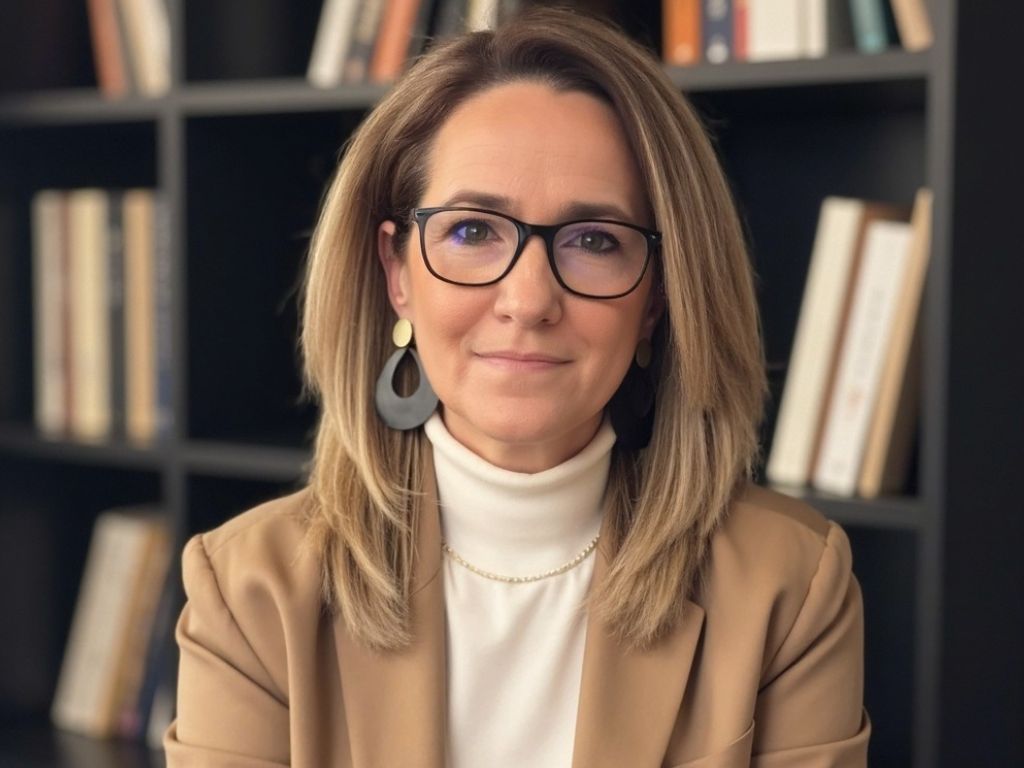
With over 18 years of experience in finance, Aurora Papuc-Peșteșan shares her transition from full-time executive roles to fractional CFO and the value of financial clarity in business decision-making.
Aurora Papuc-Peșteșan is CFO at Access Financial Services IFN S.A. and has over 18 years of experience in finance, working alongside entrepreneurs and management teams in banking, insurance, IT, IFN, and HORECA. After a solid career in full-time executive roles, she chose to combine the CFO role with fractional leadership projects, supporting companies at key moments of growth and restructuring. Her approach is pragmatic and hands-on, focused on fast results and decisions based on clear numbers. She believes in partnerships built on trust and in the role of finance as the engine of a healthy business.
Fractional Insider: How was your transition from a traditional career to fractional leadership / consulting?
Aurora Papuc-Peșteșan: It was not a sudden leap; I see it as a natural evolution. I never dreamed of becoming an entrepreneur. After 18 years in full-time executive roles, in corporations, banks, insurance, IT, IFN, and HORECA, at one point, during an M&A process, one of my clients told me: “This is the first time I understand what a CFO is telling me,” and proposed a short collaboration. I accepted, thinking it would be something temporary. That was when I realized that my greatest impact appears in key phases: structuring, growth, reorganization, professionalization, and people leadership during periods of change.
The role of fractional CFO came naturally, as a form of professional maturity, not as a rupture.
Fractional Insider: What attracted you most to this model and what challenges did it bring?
Aurora Papuc-Peșteșan: The most beautiful thing was seeing fast results and satisfied people after every project, small or large. I was drawn to the idea of meaningful freedom, of getting to know new organizations, great people, and having a shared purpose. A strong connection is created between business and people.
The freedom to choose projects comes with the responsibility to deliver value quickly.
The challenge is that there is no “adjustment period.” We all know the onboarding model with the “first 90 days” strategy. This is not the case here 😊. You enter an organization and must quickly understand the people, the business, the problems, the opportunities, and the real tensions.
You need to know that you will not deliver only numbers and strategies; you may deliver a new way of working for an entire organization. You must earn people’s trust and make sure you have all the puzzle pieces before offering the requested consulting. In the end, both the business and the people must have a real benefit. I help them understand that numbers tell a story and that, after I leave, they are responsible for continuing that story.
Fractional Insider: How do you choose the projects and clients you work with?
Aurora Papuc-Peșteșan: As I mentioned earlier, this role gives you the freedom to choose, and I took full advantage of that. I relied heavily on chemistry and honesty. If there is real openness to change and a willingness to make real decisions, not just to tick a box, then I know I can help.
I am not interested in perfect projects, but in sincere ones, with people who believe things can be done differently.
Fractional Insider: Tell us about a moment when you had a major impact as a fractional leader.
Aurora Papuc-Peșteșan: The term “major impact” is debatable, because impact means different things for different organizations. For some, major impact means a return to profitability or double-digit margin growth. For others, with stable profitability, it means reorganizing the finance department or improving the reporting structure.
A project very close to my heart was a collaboration with an entrepreneur who told me from the start: “I don’t know exactly what’s wrong, I just know that I don’t understand anything from the numbers I receive from the accountant.”
There was honesty, even though there was not yet a clear structure. In a few months, we put order into cash flow, clarified the real margins, established reporting based on specific KPIs, and the accounting team began to deliver with meaning.
Fractional Insider: What are the main differences between being a full-time executive and a fractional one?
Aurora Papuc-Peșteșan: As a full-time CFO, you are present in all aspects of the business. You live the rhythm, the pressure, and the internal politics. The beautiful part is that, most of the time, you have time. Time to build, to take things step by step, organically. And sometimes, precisely because of this, things you might overlook can appear.
As a fractional, you come from the outside, with a different perspective and a clear mandate. In this role, you start asking those difficult questions that are harder to ask from within: “Why?” The role of a fractional is not to contradict, but to complement. To bring balance between the team’s internal experience and an external, objective perspective. It is a partnership.
The full-time CFO builds from the inside, while the fractional supports acceleration and clarity from the outside. They are different roles, but deeply complementary.
Fractional Insider: How do you explain the value of a fractional to a skeptical CEO?
Aurora Papuc-Peșteșan: Fortunately, I have not encountered a skeptical CEO. Most of the time, especially in the case of entrepreneurs, the CEO already also plays the role of CFO: making financial decisions, liaising with the bank, the accountant, or clients. This is precisely why they are, in fact, the ones who request this type of support.
The value of a fractional CFO comes from taking over a critical part of this pressure and bringing structure, clarity, and experience where the founder or CEO is already overloaded. It does not come to take control, but to offer a partner for better financial decisions.
The CEO knows they need support, and my role is to help them regain or maintain focus on their business.
Fractional Insider: What are the most common mistakes companies make when working with fractionals?
Aurora Papuc-Peșteșan: Expectations, time, and clarity.
Unrealistic expectations, insufficient time allocated to the collaboration, and lack of clarity regarding deliverables. Most of the time, companies want fast results, which is understandable. However, it is essential that sufficient time is allocated. From my experience, these mistakes can be avoided if things are clarified from the beginning.
At the same time, companies must understand that a fractional is not a magician. Every time you step in to solve one problem, “Pandora’s box” opens, and others appear 😊.
A fractional can bring structure and direction, but needs a clear framework: what problem we are solving, within what time horizon, and with what level of involvement from management. When these things are understood from the start, the collaboration becomes very efficient and delivers concrete results.
Fractional Insider: How do you see the evolution of this career model in the coming years?
Aurora Papuc-Peșteșan: Organizations’ interest in decisions based on numbers, clear reporting, and well-defined structures has increased. Many organizations are not large enough to need a full-time CFO, but they do need that behind-the-scenes partner, that person who provides the right direction.
This makes the role of fractional CFO increasingly sought after.
Fractional Insider: What advice would you give to a senior professional considering becoming fractional?
Aurora Papuc-Peșteșan: First of all, I would advise them not to rush to leave their current role until they clearly understand whether this model is truly what they are looking for.
In practice, the role is not always just about strategic decisions. Very often it means rolling up your sleeves, being hands-on, working side by side with people, building reporting models, budgets, cash flows, or processes from scratch that did not exist before.
It is not about sitting in a chair and giving directions, but about being present alongside teams, both management and accountants, analysts, or operations people, and translating strategy into concrete things that actually work.
Aurora Papuc-Peșteșan’s journey shows that modern financial leadership is no longer just about numbers, but about creating meaning, structure, and trust at critical moments for organizations. The fractional CFO role becomes a strategic partnership, where experience, clarity, and hands-on involvement can accelerate decision-making and support sustainable growth.