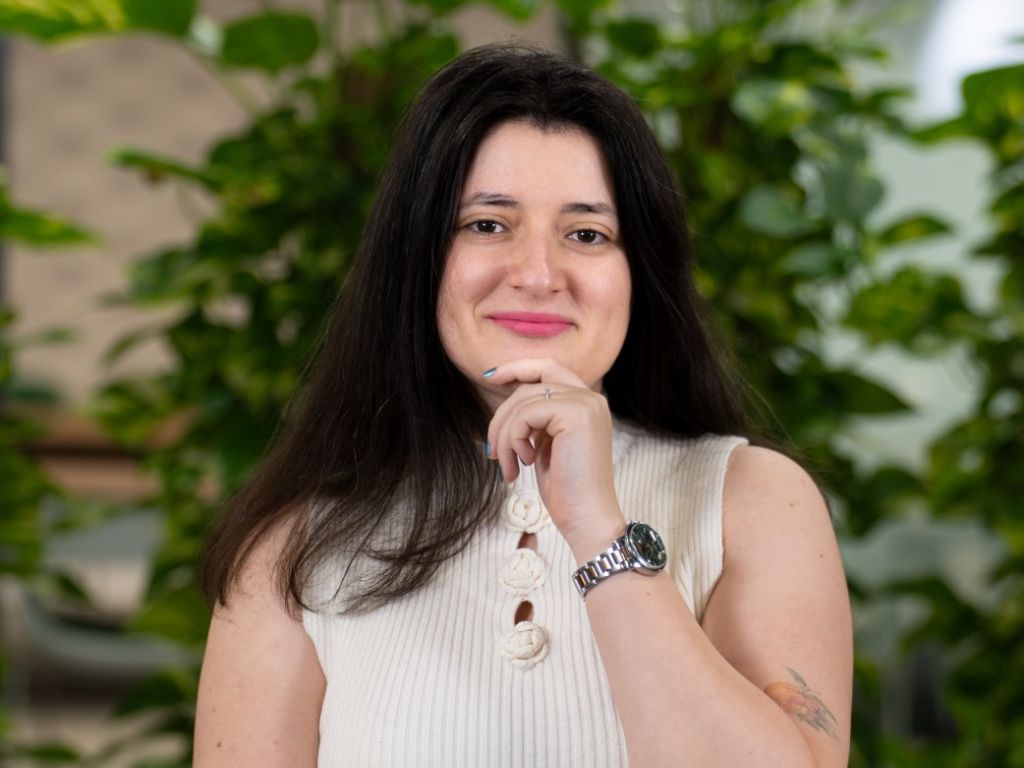
An in-depth interview with Denisa Niculescu, C-level Executive and fractional COO, exploring her transition to fractional leadership, operational impact, model challenges, and advice for senior professionals.
Denisa Niculescu is a C-level Executive with experience in coordinating end-to-end operational functions in startup and scale-up environments. She has a proven ability to build business infrastructure from scratch, optimize workflows, ensure compliance, and support growth through cross-functional collaboration. She is recognized for her practical approach, business mindset, and ability to turn chaos into clarity.
Fractional Insider: How was your transition from a classic career to fractional leadership/consulting?
Denisa Niculescu: I can’t say I had a transition in the traditional sense. With the pandemic, the IT market in Romania began to explode, and I quickly identified the need startups had in the operational and financial areas. Considering that most founders had a technical background, they preferred to focus on product, not bureaucracy. At the same time, being early-stage, hiring a full-time COO was a hard cost to justify. That’s where I stepped in and focused my service offerings exactly on this need.
Fractional Insider: What attracted you most to this model, and what challenges came with it?
Denisa Niculescu: The pleasant part of this business model is the diversity of challenges. I quickly discovered that every company I work with has a similar foundation, yet remains unique. The fact that I’m always involved in activities that help that company create a real impact in society gives me energy. And, as I like to say, “not a boring day at the office.” Of course, this model also comes with its challenges: sometimes I switch direction and focus two or three times a day, which is why I always have my agenda with me, writing down even the smallest details, courses, and books about effective leadership and developing the ability to integrate quickly into very different teams and organizational cultures.
Fractional Insider: How do you choose the projects and clients you work with?
Denisa Niculescu: I always start with a few alignment discussions and a small discovery process to see whether I can have a real impact in the company and whether we are compatible in terms of values and organizational culture. When I take on a project, I give 100%; I don’t want to get involved just to check a box on my CV. I like working where I feel I can build something concrete and, in the end, be able to say I brought real change.
Fractional Insider: Tell us about a moment when you had a major impact as a fractional leader.
Denisa Niculescu: I have an expression I like: “before you take the company out into the world, the house needs to be organized.” I saw the impact of this approach in a growing company without a complete operational department. After creating and implementing operational workflows, processes, and policies, the company was able to grow without losses or bottlenecks. It was very satisfying to see how operational order supports real success.
Fractional Insider: What are the main differences between being a full-time executive and a fractional one?
Denisa Niculescu: The difference between a full-time executive and a fractional one is that, in the first case, you focus on a single company, with ups and downs, and long-term involvement. As a fractional, you have a different perspective on the company and are not influenced by the industry or organizational culture, because you are not rooted in the company. You bring your know-how and provide the clarity that is sometimes hard to see when you’re involved in the day-to-day activities.
Fractional Insider: How do you explain the value of a fractional to a skeptical CEO?
Denisa Niculescu: A fractional leader is not suitable for all companies. If the CEO is skeptical and leads a company looking for long-term stability, where things are already clear and well-structured, I don’t believe a fractional can bring value. However, if the CEO is in a company that is early-stage or in the middle of change, and needs someone with targeted expertise for structure or quick validation of a strategic direction, then the company’s needs fully validate the role of a fractional leader. I have a full-time executive role in an IT company where things are established, but the projects where I contribute as a fractional COO appear exactly in situations where I can bring clarity and solve specific operational needs.
Fractional Insider: What are the most common mistakes companies make when working with fractionals?
Denisa Niculescu: Sometimes people think a fractional will solve everything alone, but the real value comes from collaboration with the team. Operational workflows, solutions, and decisions are built together. There are also situations where objectives are not yet clear. As a fractional COO, things are a bit simpler: the basic ingredients are the same, only the “recipe” changes. However, if you bring in a Sales Fractional and the objectives are unclear or change weekly, it becomes very hard to have a real impact.
Fractional Insider: How do you see the evolution of this career model in the coming years?
Denisa Niculescu: I think we’d all love to have a crystal ball and see the future, but for now, that’s not possible. What I can say is that my career evolution in this model will continue at the same pace in the coming years: I will keep learning, experimenting, and maintaining a bit of stubbornness. I notice a growing trend for fractional leaders in specific areas: operations, marketing, sales, and I believe this pace won’t slow down; more and more companies will adopt this model.
Fractional Insider: What advice would you give a senior professional considering becoming fractional?
Denisa Niculescu: You need to set expectations from the beginning and avoid resistance to the unknown. In a fractional role, new and unexpected things always come up, and the comfort zone is not guaranteed. Because we learn from mistakes, early in my career I had the tendency to say “yes” to everything, whether it was part of my expertise or not. Learning to say “no” is essential and should be learned early. I’ve always had a clear plan, with steps, objectives, and deadlines, knowing exactly what I wanted from my career.
Denisa Niculescu’s professional journey shows that fractional leadership is more than a trend — it’s a mature solution for companies seeking clarity, structure, and targeted expertise.