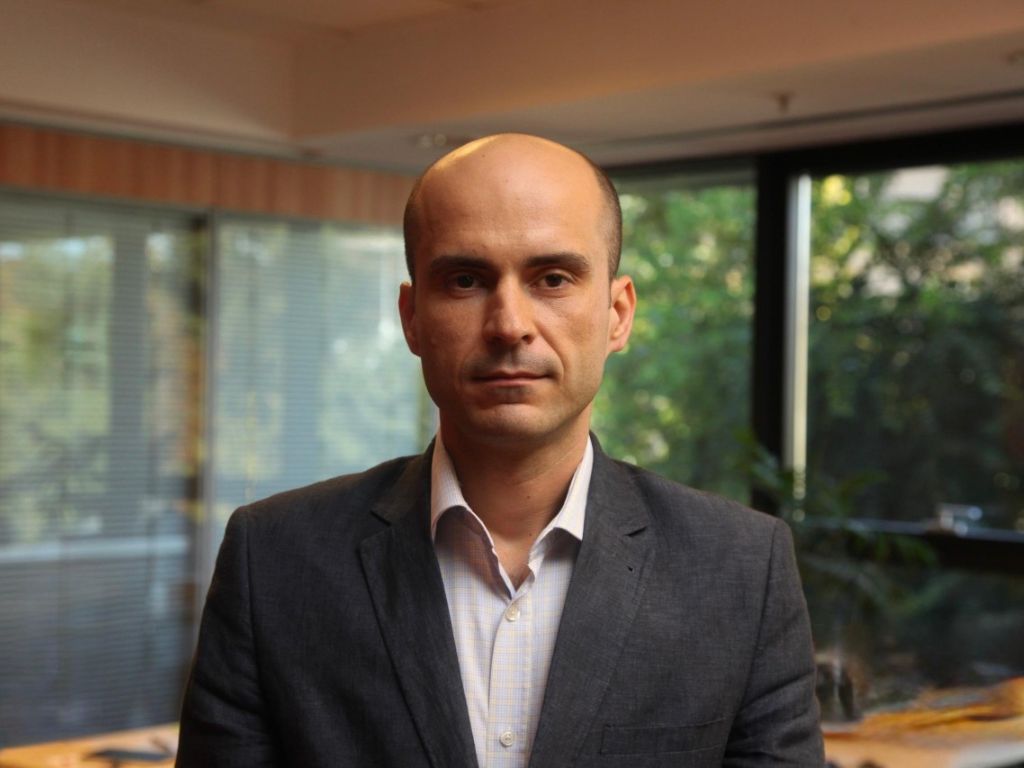
Discover how Csongor-Aron Danguly turns the fractional CFO role into a strategic partner for CEOs, bringing clarity and smart financial decisions to growing companies.
Csongor-Aron Danguly is a Fractional CFO with over 20 years of experience in business consulting, financial audit, and executive roles across various industries.
He is a CFO with strong financial expertise, business-oriented and actively involved in the strategic decisions of multiple companies.
“A business-focused CFO is not the guardian of the budget, but the CEO’s co-pilot – the person who turns uncertainty into clear decisions and sustainable actions,” he states with conviction.
Fractional Insiders: How was your transition from a classic career to fractional leadership/consulting?
Csongor-Aron Danguly: For me, the shift toward the fractional model was more of a natural evolution of my professional journey.
The period spent in the Big 4 was an intense training stage, where I built a solid foundation in financial analysis, accounting, and taxation, but most importantly, I learned how every operational decision — no matter how small — is reflected in the numbers. It was the moment when I realized that finance is not just about reporting, but about the story behind the numbers.
Then I moved into the executive area, as CFO in companies at different stages of development — from local scale-ups to multinational organizations. That’s where I learned what it truly means to be the CEO’s co-pilot: to bring balance between vision and reality, between opportunity and risk.
After years of seeing how businesses function from the inside, I chose to leverage this experience in a more dynamic way – by working simultaneously with several companies and offering strategic support exactly where a CFO’s expertise makes the difference.
Fractional Insiders: What attracted you the most to this model, and what challenges did it bring?
Csongor-Aron Danguly: What attracted me was the role of strategic partner. As a fractional CFO, I can work with founders and management teams on essential decisions – how to grow, how to prioritize investments, how to align financial resources with strategy. It is a “translator” role between financial language and operational language, a position of partnership – not just a financial function.
The major challenge is earning trust quickly and proving that finance is not a brake, but an accelerator for smart decisions.
Another challenge is the speed – in just a few weeks you must understand the company, its culture, its challenges, and deliver solutions that can be implemented with immediate impact.
Fractional Insiders: How do you choose the projects and clients you work with?
Csongor-Aron Danguly: I collaborate with companies at inflection points – accelerated growth, fundraising, scaling, or business model transformation.
I look for companies that want to look at numbers not just to understand them, but to make better decisions. I am interested in places where commercial and financial decisions intersect – that’s where the biggest impact is created. The main criterion is not the size of the company, but the maturity of its leadership. I work with founders who want transparency, clarity, and forward-looking financial thinking. When a CEO is open to dialogue and has the courage to ask for clarity, real results can be built.
Fractional Insiders: Tell us about a moment when you made a major impact as a fractional leader.
Csongor-Aron Danguly: One of the collaborations that stayed with me was with a B2B tech company going through a phase of rapid growth but low profitability. After a portfolio analysis, I identified that almost one-third of the projects generated hidden losses, even though they “looked” good in the raw numbers. I recalibrated the pricing model, redefined the profitable segments, and introduced financial logic into commercial decisions.
The result: the operating margin almost doubled and the team, for the first time, approached every commercial decision with financial thinking.
Fractional Insiders: What are the main differences between being a full-time executive and a fractional one?
Csongor-Aron Danguly: A full-time role involves daily operational management. As a fractional, you position yourself as a decision partner. It is a leadership model focused on results, not presence.
You are no longer “in” the business day-to-day, but “above” it – bringing clarity, connecting numbers with vision, and helping the team make data-based decisions rather than intuition-based ones. You have less time, but a more objective perspective, which helps you see where value is lost and how it can be corrected.
You must be extremely efficient and clear in communication. In just a few hours per week, you must deliver real strategic value. It is a discipline of priority and impact.
You also need to be comfortable influencing without formal authority – meaning you earn respect through expertise, not through job title.
Fractional Insiders: How do you explain the value of a fractional leader to a skeptical CEO?
Csongor-Aron Danguly: I tell them simply: “You get the expertise of a senior CFO, but tailored exactly to your needs and budget.” Essentially, you bring corporate-level know-how into a business that is growing or going through complex changes, without the cost of a full-time executive. Often, after the first months, the skepticism disappears – the results speak for themselves.
Fractional Insiders: What are the most common mistakes companies make when working with fractionals?
Csongor-Aron Danguly: The most common mistake is treating the role as an operational one. A fractional CFO brings strategic thinking, not just financial execution.
The second mistake is the lack of clarity at the beginning of the collaboration. When objectives are not defined, the direction becomes unclear. And perhaps the most subtle mistake: not involving the CFO in discussions about business plans, in management meetings where, in fact, most of the financial impact is generated.
Fractional Insiders: How do you see the evolution of this career model in the coming years?
Csongor-Aron Danguly: The fractional model naturally responds to the needs of modern businesses, which require speed, flexibility, and expertise exactly where needed.
Companies no longer need full-time leadership, but leadership at the right moment. Not all companies need a full-time CFO, but almost all need a strategic financial perspective.
In the coming years, I am convinced this model will grow significantly: we will see more mixed teams, with full-time and fractional executives, adapted specifically to the company’s needs and development stages.
Fractional Insiders: What advice would you give a senior professional considering becoming fractional?
Csongor-Aron Danguly: A professional choosing the fractional model must adopt an entrepreneurial approach. They must clearly define their value proposition, their niche, and their delivery model. A fractional does not just sell expertise; they sell trust, impact, and clarity.
For a fractional CFO, it is essential to stay connected to business, not just to numbers – because numbers without context remain mathematics, not strategy.
And finally, they must enjoy the freedom of choosing – because that is the very essence of the fractional model.
Csongor-Aron Danguly demonstrates that the role of a fractional CFO goes beyond numbers and reports – it is about being a strategic partner who brings clarity, vision, and smart decisions to companies.