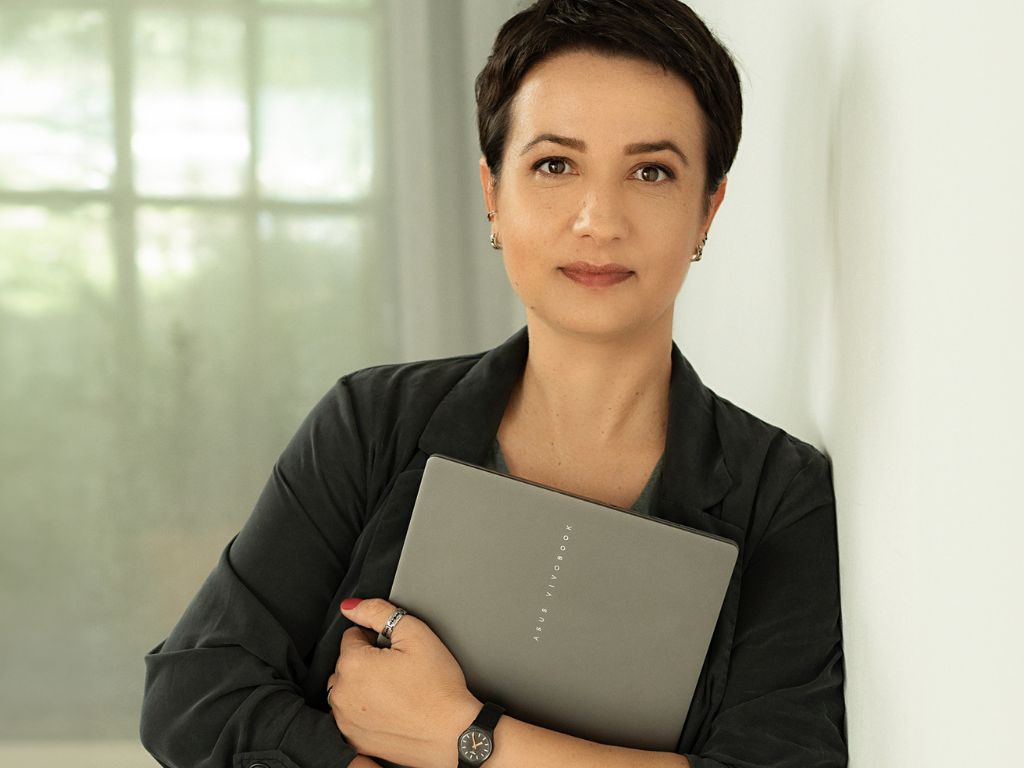
An inspirational interview with Julia Krisztina Kabdebo, Fractional CFO, about her transition from the corporate world to fractional consulting, the challenges of uncertainty, and the genuine satisfaction of having a direct impact on entrepreneurial businesses.
Julia Krisztina Kabdebo is a Fractional CFO with extensive experience in strategic financial management, performance analysis, and operational optimization for growing companies.
Fractional Insider: How was your transition from a traditional career to fractional leadership/consulting?
Julia Krisztina: In terms of the actual work I do, I can say the transition happened quite naturally. I had accumulated a lot of corporate experience — 10 years by the time I decided to go independent. But as a transition process, it wasn’t without its challenges, and it still is one. Moving from an extremely predictable environment that offers comfort on all levels to one where much of your energy goes into managing uncertainty is no easy feat.
At first, when the idea started to take shape in my mind, I was a bit skeptical about whether I could really do this on my own. I wondered whether what I used to do in the corporate world — FP&A, controlling, and finance business partnering — would even make sense for smaller companies that don’t have the same level of complexity. And surprise! It makes a lot of sense — in fact, it has a much greater impact than I would have expected.
And it also brings much more satisfaction, because the impact is significant in entrepreneurial companies — from the joy of collaborating with diverse people and teams to directly contributing to business scaling and strengthening investor confidence.
Fractional Insider: What attracted you most to this model, and what challenges did it bring?
Julia Krisztina: I realized some time ago that the traditional employee model no longer suited me. Things were moving slowly and had become boring — the same processes, the same people. Everything felt monotonous, even when I changed companies. It’s true that I had an intermediate phase before fully transitioning to the fractional model — I worked in a startup where I built a financial controller role from scratch.
What attracted me was the opportunity to switch to an industry closer to my passions. I loved that I could work with more people, more companies, and choose to collaborate with people I liked — business models I believed in and industries where the human and creative sides are highly valued.
The change came from a desire to focus on industries where the human and creative elements are part of the business — but also to bring more humanity into my own work. The work of a fractional finance leader, even though it involves analysis and numbers, also requires a great deal of communication, leadership, and the ability to influence the CEO’s decisions.
If, as a fractional, you can’t influence the CEO’s decisions through your work, something isn’t working.
Fractional Insider: How do you choose the projects and clients you collaborate with?
Julia Krisztina: First of all, when I decide to work with a company or an entrepreneur, I make sure we share at least some common values — and that there’s a kind of chemistry.
After leaving the corporate world, I wanted even more flexibility and autonomy than I had before. In the companies I worked for in recent years, I was lucky to meet open and flexible people — perhaps even more flexible than me, haha. I hope they’ll see this article because I mean it in a good way.
I choose to work with people I care about, who share my values, with whom I communicate well, and whom I genuinely want to help take their business to the next level — or at least do everything in my power to make that happen.
In other words, I work with people and projects I believe in — ones that motivate me to push through even when things get tough.
Fractional Insider: Tell us about a moment when you had a major impact as a fractional leader.
Julia Krisztina: There’s quite a bit to tell here — several moments come to mind.
These impactful moments as a fractional leader tend to come with experience, and over time they take on different forms. I’d say there were two major ones, though different in meaning for an entrepreneur.
One of the key moments was when I managed to change the CEO’s perception of the role of a fractional finance manager.
At first, for him, everything finance-related was irrelevant: “Accounting handles that — I focus on sales and business, it’s not my thing.”
That’s a common mindset — I had encountered it in corporate settings as well, especially with leaders from sales backgrounds, so I wasn’t surprised. For quite some time, I worked more independently — until we started delivering results and gaining visibility over the numbers, something that hadn’t existed at all before. That was a turning point. From that moment, I could see genuine interest in what this role could bring — and in how a fractional leader’s insights could be integrated.
That was the first major moment — shifting perception and involvement, from reluctance to genuine strategic discussions.
The second major moment came naturally right after that first one — when, having achieved strong visibility over financials and performance, we could look ahead to launching new projects, securing funding, and attracting investors.
Because visibility was now established and we had drawn clear conclusions, we could move on to strategic planning and budgeting. This allowed us to build a multi-year plan with direction and a concrete action path to reach those goals. The result was increased investor trust and a greater willingness to support the company and its new projects.
In conclusion, the first moment changed perception and opened minds, while the second consolidated trust and brought tangible results.
Fractional Insider: Your experience in stand-up, improv, and acting seems quite different from business. What have you discovered about yourself through this artistic side, and how has it helped you grow?
Julia Krisztina: I believe we humans are an amalgam of contradictions, with skills and passions that often seem unrelated. But these seemingly opposite abilities — and the balance between them — are what make us unique. Our ability to honor all sides of ourselves and bring them into harmony brings fulfillment not only to us but also to those around us.
Fractional Insider: What are the main differences between being a full-time executive and a fractional?
Julia Krisztina: I can’t really say what the difference is between a full-time and a fractional executive because I never reached a full-time executive role. I left the corporate world from a senior finance & business partner position, and as a fractional, I evolved into a finance manager and later a Fractional CFO.
In large corporations, even at senior leadership levels like Senior Director, you’re dealing with a puzzle made of many pieces — very complex — but you don’t manage the entire puzzle.
By contrast, a fractional leader working with smaller companies faces a puzzle with fewer pieces, less complexity — but manages the entire thing. You need strong analytical, strategic, and planning skills, but also a solid understanding of accounting, legislation, taxation, operations, processes, and even audit — the list goes on.
Fractional Insider: How do you explain the value of a fractional to a skeptical CEO?
Julia Krisztina: Honestly, I don’t think you should. It’s like trying to teach someone math using only theory — it’s frustrating for both sides.
From experience, I believe that a CEO or entrepreneur without prior exposure to corporate environments or similar roles cannot fully grasp the value of a fractional leader right away. This understanding develops through positive experiences and tangible results.
But to answer the question — I would invite the CEO to tell me about their business challenges, what frustrates them, what brings them satisfaction, what they’re willing to change, and what they’re not. This way, I can understand their needs and create a dialogue — not just show up with an Excel sheet they’re supposed to “get.”
Fractional Insider: What are the most common mistakes companies make when working with fractionals?
Julia Krisztina: I think the mistakes tend to appear on both sides. Personally, coming from a banking background where accuracy and data control are critical, I’ve sometimes struggled to let go of control and found myself too involved — almost like a full-time employee, which isn’t reasonable for a fractional.
On the other hand, companies working with fractionals are often not ready to fully integrate the changes, insights, and know-how that a fractional brings. There’s often friction and resistance to process change, so much of a fractional’s work may remain unimplemented — and the improvements that could elevate the company stay unrealized.
Fractional Insider: How do you see this career model evolving in the coming years?
Julia Krisztina: In the bubble I live in :), this model still feels quite new. I haven’t met many people doing this yet, so I think we’re at the early stages. That’s part of why it’s challenging — we’re still building the framework for understanding what a fractional CFO does and why it’s valuable. Over time, I think it will become more common, and we’ll spend much less time explaining its utility.
There’s a real need for it because accounting exists so the state can collect taxes — but it doesn’t help entrepreneurs truly understand their numbers or build strategy.
There are no scalable businesses built on inertia, and this is where the role of a fractional leader is essential. The Fractional CFO is the CEO’s co-pilot — providing visibility and clarity, allowing the CEO to focus on decisions instead of wasting time searching for the information they need to make them.
Fractional Insider: What advice would you give to a senior professional considering becoming fractional?
Julia Krisztina: First, I’d say that corporate experience — despite all the complaints we know so well — is an incredibly strong foundation, both for hard and soft skills. It’s essential to be a critical thinker, someone who doesn’t take things for granted, who asks questions, and constantly evaluates their work. You need to be curious and to enjoy autonomy — I think that’s fundamental: you have to truly love autonomy and, in a way, love control. Here’s one place where control is a good thing 🙂
The rest is discovered along the way — and it’s deeply personal.
Julia Krisztina Kabdebo’s transition from the corporate world to the role of Fractional CFO perfectly illustrates the natural evolution of leaders seeking more autonomy, purpose, and real impact.