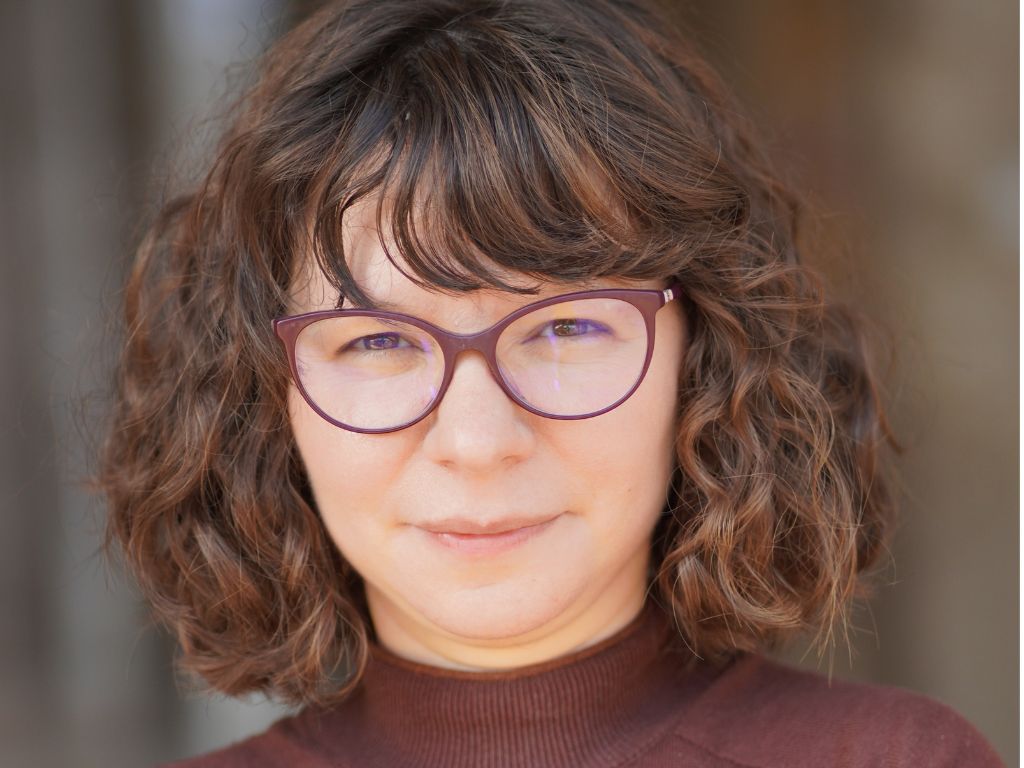
Oltea Belciuganu, Brand & Marketing Consultant and Chartered Marketer, talks about the transition from a traditional career to fractional consulting, exploring the challenges and rewards of a new leadership model.
Oltea Belciuganu is a Brand & Marketing Consultant for entrepreneurial companies, Chartered Marketer, PhD candidate researching the topic of nation branding, and occasionally, an associate lecturer at the Faculty of Marketing, Bucharest University of Economic Studies (ASE).
Her experience in branding and marketing spans over 20 years, having started working during her university studies and advancing to the position of Marketing and Communication Director. Her corporate career took her through several industries, with the most notable results achieved in banking, but also in IT&C and e-commerce.
As a consultant, she has been active for about four years, both independently and in collaboration with consultancy platforms that bring together professionals with diverse profiles and strong expertise in their respective fields.
Fractional Insider: How was your transition from a traditional career to fractional leadership/consulting?
Oltea Belciuganu: In the first few months, the hardest barrier I had to overcome was the fear that my extensive experience in the financial sector would prevent me from adapting or understanding other industries. Fortunately, it quickly became clear to me that by applying an initial audit model—getting to know the business, the owners, the team, the market, and the clients—you’re entering a school in itself. This process is not only essential to addressing the client’s issues, but also an endless source of learning and growth for you as a consultant and as a person. You become more aware of what lies behind numbers such as profit or turnover. Once I understood this, every new project felt like being a child in a toy store—excited to meet new people, all so different, to hear their stories, and to learn what drives them. This is probably one of the biggest satisfactions of this type of work compared to being in one company and one role for years.
To explain a bit more about what I do, since this working model is not yet very widespread: I’m a type of consultant who acts like a doctor—you get examined, tested, maybe even scanned, we talk, and only after this process I tell you the diagnosis and prescribe the course of action. Sometimes the doctor stays with you for a while, just to make sure you’re on the right path. Similarly, my process includes an intense initial stage (but a necessary one), where I talk to everyone relevant—from the owner to the driver, from the biggest client to the unskilled worker—read everything available (reports, analyses, research), and visit sites, stores, or distributors if needed, or scan the company’s online presence if that’s what matters most. Then I make strategic proposals and recommendations for implementation. Sometimes I stay on to oversee the implementation, alongside the internal team or other consultants, or help with team selection.
Fractional Insider: What attracted you most to this model, and what challenges did it bring?
Oltea Belciuganu: What’s most attractive—if you like adrenaline—is that every new project starts from zero, even if you’ve done work in the same field before. Personally, I find it important to start without preconceptions or ready-made recipes that worked elsewhere. I simply want to understand everything as if it were the only business of its kind, and only then position it—see where it stands and where it aspires to be.
What’s most discouraging for me is when, after the solutions are discussed, adapted, and accepted—after we’ve found the right answers—the implementation gets lost along the way, partially or entirely.
Fractional Insider: How do you choose the projects and clients you work with?
Oltea Belciuganu: To put it elegantly, this isn’t exactly a time when consultants in this field have waiting lists. However, it’s very important to me to work with people who understand that a serious working process is the one I described earlier—that we can’t skip steps to save time, because that’s unprofessional and even counterproductive. You can’t jump straight to suggesting “five Instagram posts and three TikToks,” because that rarely works. To extend the analogy—it’s like going to a doctor for a headache, and without looking at you, without asking questions, they just give you a pill that fixes the pain temporarily. But in the long run, you don’t know what caused the headache, whether it was something serious, or whether that pill will react badly with something else you’re already taking.
In other words, my advice for entrepreneurs who think they’re optimizing by cutting out the essential audit phase is—don’t. You’ll always find someone willing to work that way, but trust me, those efforts are either wasted or won’t scale.
Fractional Insider: Tell us about a moment when you made a major impact as a fractional leader.
Oltea Belciuganu: Two moments come to mind—both “aha moments” during audit interviews. Sometimes we ask questions that seem simple or obvious, like “What does your company actually sell?” or “Why do your ads look like glossy magazine pages when that’s not what you sell?” I’ve learned that not skipping such simple questions can uncover deeper dilemmas about positioning or target audiences. From there, you can sometimes make campaigns work that otherwise looked perfect on paper but didn’t perform.
However, the real impact of such collaborations doesn’t lie in a campaign or a few posts. The true impact is in structuring, optimizing, and developing brand and marketing operations aligned with the founders’ vision and the business needs—helping the internal team reach the next level. The impact I find meaningful is clarifying what needs to be done, helping the company start doing it, and then seeing results reflected in their numbers over time.
Fractional Insider: What are the main differences between being a full-time executive and a fractional one?
Oltea Belciuganu: Each has its pros and cons. The key contrasts might be: stability but possible stagnation versus uncertainty but dynamism; a clear job description versus being a “Jack of all trades”; deep specialization versus diverse, short-term projects; getting paid by HR versus paying yourself—and, of course, dealing directly with the tax authorities. I don’t yet have a definitive answer about which path is better; I simply believe each suits a different moment and personal context in life.
Fractional Insider: How do you explain the value of a fractional to a skeptical CEO?
Oltea Belciuganu: Honestly, I haven’t been in that situation. The people I’ve met usually had fast-growing companies and realized they needed something different, or had a specific challenge they couldn’t solve internally, or had a big project—bigger than anything they’d done before—and needed external support. All of them were aware that bringing in experienced people was a necessary investment and wanted to go through the process step by step.
Still, if I had to give an answer, I’d say that sometimes an experienced outsider can see what you can’t see, can ask the questions you haven’t thought of—or those you consider too obvious to ask. Someone from the outside doesn’t know what “can’t be done” and believes you can do much more than you imagine—and, surprise, they’re often right!
Fractional Insider: What are the most common mistakes companies make when working with fractionals?
Oltea Belciuganu: Although I haven’t personally experienced it, I think a potential issue would be having several fractional professionals covering different areas who don’t communicate with each other—or worse, who conflict. For instance, having someone work on strategic positioning and another team in creative who don’t understand or adopt that strategy. Fortunately, I’m part of communities of highly experienced professionals with diverse specializations, so whenever needed, we can recommend trusted people to continue the work. It’s also important to have the strength and elegance to recognize when your mandate is complete and it’s time for someone else to take over—which isn’t always easy.
Fractional Insider: How do you see this career model evolving in the coming years?
Oltea Belciuganu: From my perspective, I believe it will grow more and more—both for positive and less positive reasons. Many professionals, after reaching a certain level, no longer resonate with the corporate system, or they simply no longer fit what the system needs. Others who have adapted to remote work may seek flexibility. However, in my view, you can’t do this without a solid foundation of experience in your field and without continuous learning. You can’t start your career in consulting because you’ll simply be “speaking from the books.” Except, perhaps, for that 1% who invent a new field—then yes, they’ll be the ones writing the books.
Fractional Insider: What advice would you give a senior professional considering becoming a fractional?
Oltea Belciuganu: I’m not sure I have enough experience yet to give advice, but I believe it’s a deeply personal choice—one that depends on your appetite for risk, your life stage, and your flexibility to maybe not work half a day on Tuesday but instead work at 9 p.m. or on weekends. It’s a choice that requires careful thought but can bring great satisfaction, self-discovery, professional reinvention, and a deeper understanding of your personal value.
Through her extensive experience and thoughtful approach to every project, Oltea Belciuganu proves that fractional leadership is not just a flexible solution for companies but also a path to professional reinvention.